Journals are the major means for collaborating research activities among the scientific community and to collaborate research among the scientists and to carry the results to the end users and stakeholders. Pakistan Journal of Weed Science Research is a blind peer reviewed quarterly published journal. Its Editorial Board is a marvelous blend of eminent national and international scientists in the discipline. The publication of Pakistan Journal of Weed Science Research was initiated in 1988. The journal was published regularly until 1993, but beyond 1993 and up to 2001, its publication stayed discontinued due to some unavoidable constraints. The publication was revived since 2002 and the Journal is published regularly as per quarterly schedule.
Its License is CC-BY which allows users to distribute, remix and build upon our work, subject to credit the original authors. Not only downloading or copying something is allowed under this license but also text mining and other automated processes are also permissible.
Pakistan Journal of Weed Science Research upholds the principles laid down by the Committee on Publication Ethics (COPE).
Journals
-
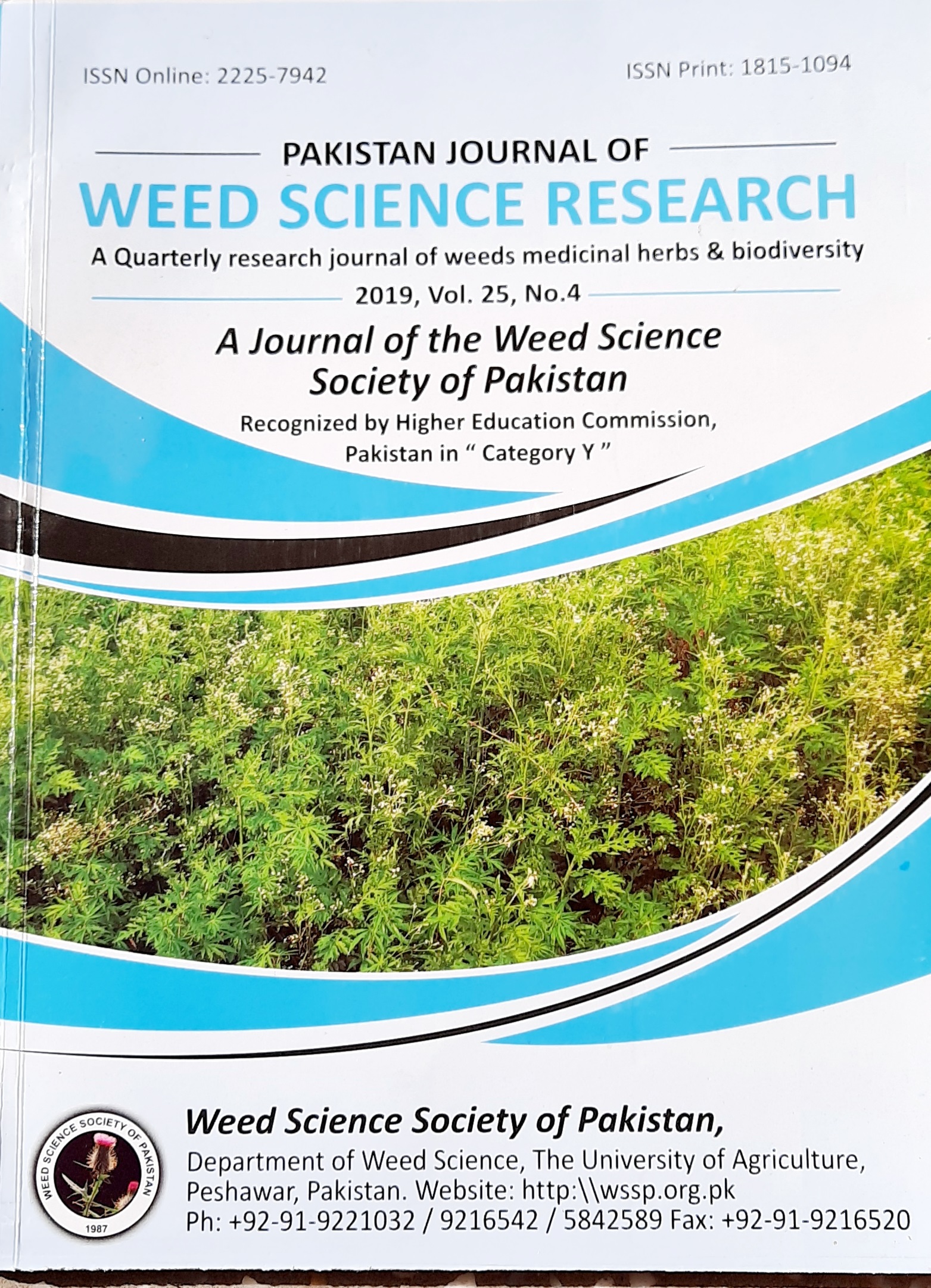
PAKISTAN JOURNAL OF WEED SCIENCE RESEARCH (Weed Science Society of Pakistan: WSSP)
In 1987. under the chairmanship of Dr. Rashid Ahmad Shad, the then Director Weed Science Research Institute (NARC), Islamabad; few veterans in weed science gathered and felt the need of establishing professional society with the name Pakistan Weed Science Society (PWSS). The pioneers of this concept were Prof. Dr. Mir Hatam, UAP. Mr. Ghulam Sarwar Khan, ARI, Tarnab, Peshawar, Dr. Sadruudin Siddiqui and Mrs. Shahida Khalid from NARC, Islamabad, Late Prof. Dr. Saeed Ahamd and Prof. Dr. Zahid Ata Cheema from UAF Dr. Asghar Jalis and Mr. Karim Bakhsh from AARI, Faisalabad and Mr. Abdul Sattar Larik from ARI, Tando Jam, Sindh. All of them unanimously supported the idea to establish Pakistan Weed Science Society (PWSS) with Dr. Rashid Ahmad Shad, as its pioneer President. He was subsequently succeeded by Late Prof. Dr. Saeed Ahmad. The society regularly held conferences and started publishing the Pakistan Journal of Weed Science Research in 1988. Under the sponsorship of USAID, Pak-Indo-US Weed Control Workshop was held on March 11-14, 1987 at NARC, Islamabad was a prominent achievement. A further boost in weed science was again by USAID, sponsoring the Coordinated Program in weeds throughout Pakistan under which Late Larry Burril and Mr. Myron Shenk from International Plant Protection Center, Oregon State University USA, trained weed scientists from all over Pakistan at NARC. With the creation of Weed Science Department at the University of Agriculture, Peshawar, the head office of the Society as well as its journal was shifted to Peshawar. Meanwhile, the name of the society was changed as the Weed Science Society of Pakistan (WSSP). The society was registered under the Societies Act of Khyber Pakhtunkhwa, declaration of the journal was officially sought and website of the society viz. www.wssp.org.pk/ was launched. The Society has so far organized 12 conferences (both national and international) at various venues in Pakistan. The society is also credited to hold 22nd APWSS Conference, from the forum of this society during 2010 in Lahore Pakistan, as Prof. Dr. Khan Bahadar Marwat Ex-President and Prof. Dr. Gul Hassan Ex-Secretary of the APWSS were and currently are the President and General Secretary of WSSP.